
A chimney is a hole in the roof by design
Every other penetration through a roof is sealed shut. A chimney is deliberately open at the top, and it passes through the roof plane at the point where two surfaces meet. In a climate that delivers Atlanta's rainfall, that combination catches up with every chimney eventually.
The result is that chimney leaks are common, unremarkable and entirely fixable — as long as the repair is aimed at the right place.
The four ways water gets in
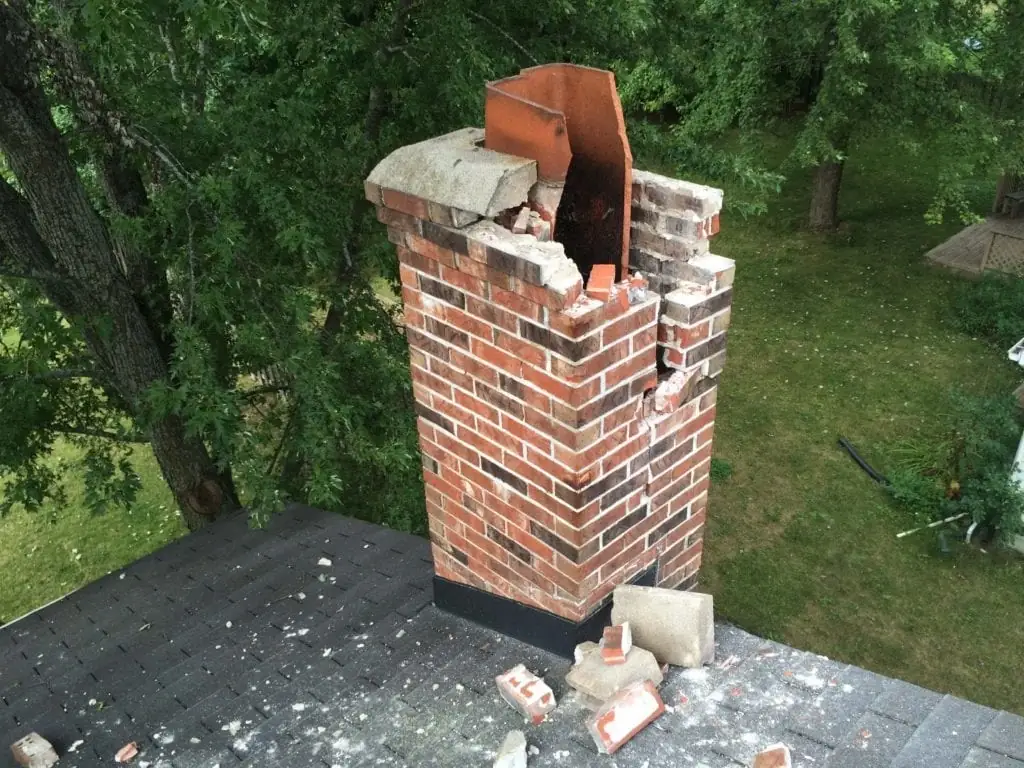
The crown is the concrete slab across the top of the stack, and it is the chimney's roof. When it cracks, water goes straight into the masonry core. A crown with no overhang and no drip edge feeds water onto the brick face even when it is intact.
The flashing is the metal joint where the stack passes through the roof. It lifts, splits and pulls away with movement, and it is the single most common failure point on a chimney that is otherwise sound.
The cap is the cheapest of the four and the most often missing. Without one, rain goes directly down the flue onto the smoke shelf and damper. And finally the brick itself: masonry that has spalled or lost its mortar joints becomes absorbent enough to take water straight through the wall.
Why the stain is in the wrong place
Water entering at the crown does not fall straight down into your living room. It runs down the outside of the flue liner, inside the masonry, until it finds a horizontal surface or a gap — which is usually where the chimney passes a ceiling, a storey or two below the actual fault.
This is why so many people pay to have a leak fixed twice. Sealant goes on where the stain is, the stain stops for a season while the sealant is fresh, and the water carries on entering at the crown exactly as before.
The diagnosis has to start on the roof, and it has to look at all four entry points, because it is entirely normal for two of them to be failing at once.
What waterproofing can and cannot do
Masonry water repellent is genuinely useful on sound brickwork that has become absorbent. It is not a fix for a cracked crown, failed flashing or a missing cap, and applying it in those cases achieves nothing.
One thing worth insisting on: the sealer must be vapour-permeable. A non-breathable coating stops water getting in and also stops the moisture already in the wall getting out, and masonry that cannot dry outward spalls faster than masonry left alone.
Want a professional to take a look?
Fluora Prime Chimmey Sweep serves 20 cities across metro Atlanta, 24 hours a day. Estimates are free and there is no obligation.
Frequently Asked Questions
Frequently both, because the failure is at the flashing — the joint between them. Photographs settle it. Whoever is diagnosing should be able to show you the entry point rather than describe it.
Sudden storm damage often is; gradual deterioration usually is not. That is exactly why a photographed, written record of what failed is worth having before you make a claim.